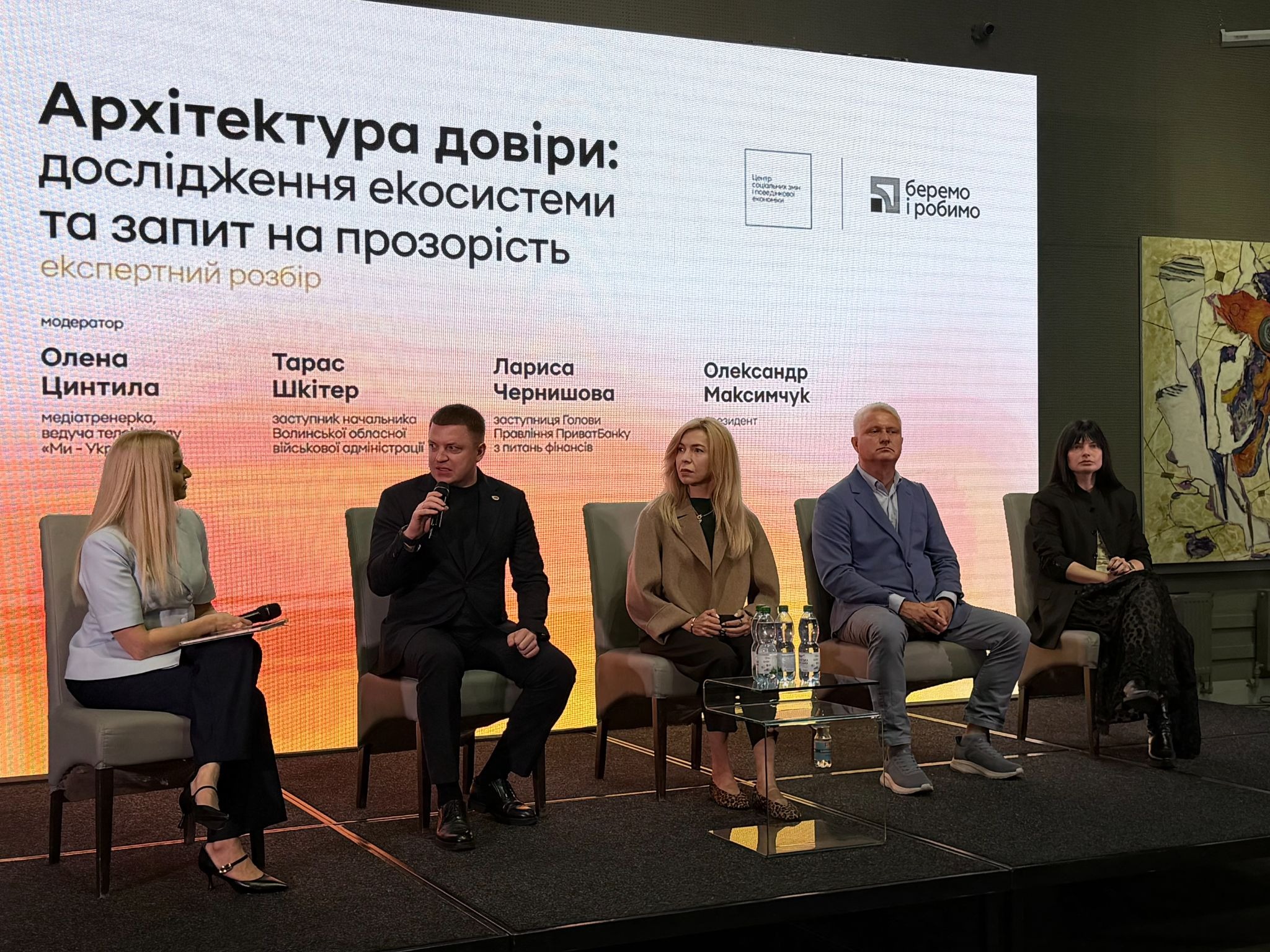
Openness, transparent financial operations, and clear rules help volunteers and charitable organizations build long-term partnerships with business, the state, and international donors, as well as maintain people's trust. This was discussed by participants of the meeting held in Lutsk as part of PrivatBank's "Architecture of Trust" project.
The goal of the project is to transform the culture of charity in Ukraine from spontaneous "card collections" to systemic professional processes.
For Volyn, which serves as an important humanitarian and logistical bridge between Ukraine and Europe, safe and transparent operations of volunteer initiatives are of particular importance, emphasized Deputy Head of Volyn Regional Military Administration Taras Shkiter.
"Volyn today is a space where the state, volunteers, business, charitable foundations, and international partners meet daily. And the more participants are involved in this system, the more important clear coordination, understandable rules, and trust between all parties become. Our task as a state is not to create additional barriers for those who help, but on the contrary, to build conditions under which this assistance can move quickly, safely, and predictably," noted Taras Shkiter.
One of the topics of the meeting was the results of a large-scale study conducted by the Institute of Sociology of the National Academy of Sciences of Ukraine and the Center for Social Change and Behavioral Economics, which helps understand how Ukrainians currently view charity and what influences their readiness to help. According to the study, over 80% of citizens consider charity an important part of life. At the same time, only about half of the respondents know whom they can unconditionally trust with their funds, while 51.2% note that they always or mostly weigh who exactly to support.
According to Doctor of Sociological Sciences, Corresponding Member of the National Academy of Sciences of Ukraine, Member of the Board of the Center for Social Change and Behavioral Economics Serhiy Dembitskyi, these results indicate growing demands of Ukrainians toward those who raise and use charitable funds. For 46.3% of respondents, an important criterion is the reputation of the fund organizers, and over 70% pay attention to the openness and reporting of foundations and charitable organizations.
"Trust in charitable organizations is formed through professionalism, expertise, honesty, and transparency. People want to understand what tools are used to collect funds and how they are managed. The reputation of a benefactor or organization has become one of the key assets. It can be managed, but only through systemic transparency, regular reporting, and real results," noted PrivatBank's Public Relations Lead, Olesya Zhulynska.
During the panel discussion, participants spoke about practical transparency tools that help charitable organizations build a reliable financial system and protect the trust of their partners. In particular, they discussed how banking tools and clear procedures can avoid complicating volunteers' work and instead create an additional level of security for them.
"When financial processes are clear and, most importantly, secure, benefactors can focus on what matters most—helping people. At the same time, for donors themselves, we guarantee the security of their contributions, full transparency, and confidence that funds guaranteed go to their intended purpose. Our role as a bank is to make these tools accessible and easy to use for all participants in the process," emphasized Deputy Chairwoman of the Management Board of PrivatBank for Finance, Larysa Chernyshova.
According to President of the Ukrainian Association of Philanthropists Oleksandr Maksymchuk, donors increasingly want to understand not only whom they are helping, but also how effectively and responsibly the organization works with received resources.
"The Ukrainian charitable sector has grown remarkably fast in recent years, and today it faces the next stage—professionalization. The speed with which volunteer initiatives turned into foundations did not always allow for building management processes, financial reporting, and internal standards just as quickly. But today, these very things determine the sustainability of an organization and its ability to attract new partners," noted Oleksandr Maksymchuk.
The practical dimension of this work was presented by Director of the Charitable Foundation 'ANGAR. Ukraine' Olha Valyanyk, sharing the foundation's experience and its interaction with partners.
"We have learned from our own experience that transparency does not work merely as post-factum reporting. It helps build trust even before a partner transfers funds to the foundation. When you have clear processes, documents, reporting, and can show results, it is much easier to speak with new partners and scale assistance," said Olha Valyanyk.
Discussion participants also spoke about the importance of synergy between business, culture, and the volunteer community.
Director of the Korsaks' Museum of Contemporary Ukrainian Art, Head of NGO 'TECHNOPARK "Center for Medical Innovations"' Tetyana Repnytska in her address highlighted the importance of partnership among culture, the civic sector, business, education, and other environments. Precisely such interaction, according to her, allows not only implementing individual initiatives, but turning them into sustainable solutions with long-term impact.
"A modern museum is not just a place where art is stored, but a space that can unite different environments and teach society interaction. It is important for us step by step to build an architecture of partnerships that will make good deeds systemic and sustainable," noted Tetyana Repnytska.
Experts are convinced: trust in charity is formed not only through good intentions. It requires openness, responsible management, clear financial rules, and partnership. Exactly such a system enables volunteer and charitable initiatives to operate for the long term, scale assistance, and remain reliable for the people who support them.
The 'Architecture of Trust' project is a joint project of the Center for Social Change and Behavioral Economics and PrivatBank.